Pushing the Limits
Fencing, jumping, spinning, flying … the art and excitement of performing stunts onstage.
By Bill Corsello
Where Guestbook New York
Over at Bring It On, boys are hurling girls 20 feet in the air; a block away, at Nice Work If You Can Get It, a beloved diva is literally swinging from a chandelier. Welcome to the life of a 21st-century theater performer, for whom acting, singing and dancing dexterity just aren’t enough anymore.
As Broadway musicals and plays get more ambitious and complex, cast members often have to be ready, willing and able to do the sort of physical feats previously seen only on the silver screen: jumps from tall perches, falls into darkened pits, flights to breathtaking heights. What does it take to perform these electrifying stunts eight times a week? A dollop of trust, an abundance of fearlessness and practice, practice, practice.
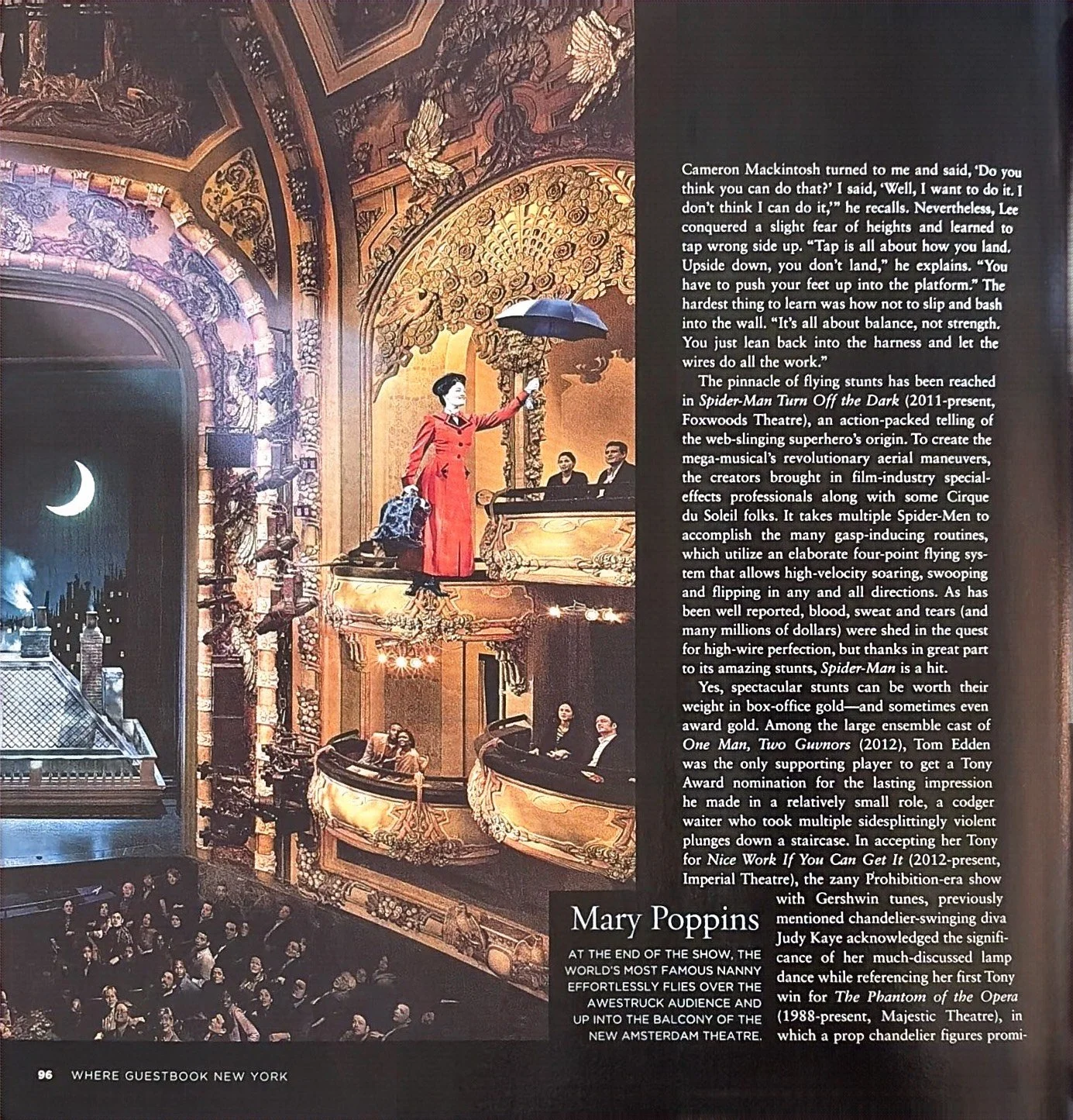
Gavin Lee had plenty of time to perfect his big stunt: nearly 10 years. As high-kicking chimney sweep Bert in Mary Poppins, the song-and-dance man mastered a never-before-seen act of derring-do. In Disney’s whimsical musical about the magical nanny, Lee leads the rousing “Step in Time” number. As it builds to a fierce climax, he astonishingly strides up the side and to the top of the theater’s proscenium (the arch that marks the division between the stage and auditorium), where he steps onto the underside of a platform and tap dances his way across the ceiling—upside down—before hoofing it face-first down the other side.
Lee’s minute-long journey began in London, when he landed the part in the original production. During the first week of rehearsals, he stared in awe as a petite circus performer demonstrated the stunt. “[Producer] Cameron Mackintosh turned to me and said, ‘Do you think you can do that?’ I said, ‘Well, I want to do it. I don’t think I can do it,’” he recalls. Nevertheless, Lee conquered a slight fear of heights and learned to tap wrong side up. “Tap is all about how you land. Upside down, you don’t land,” he explains. “You have to push your feet up into the platform.” The hardest thing to learn was how not to slip and bash into the wall. “It’s all about balance, not strength. You just lean back into the harness and let the wires do all the work.”
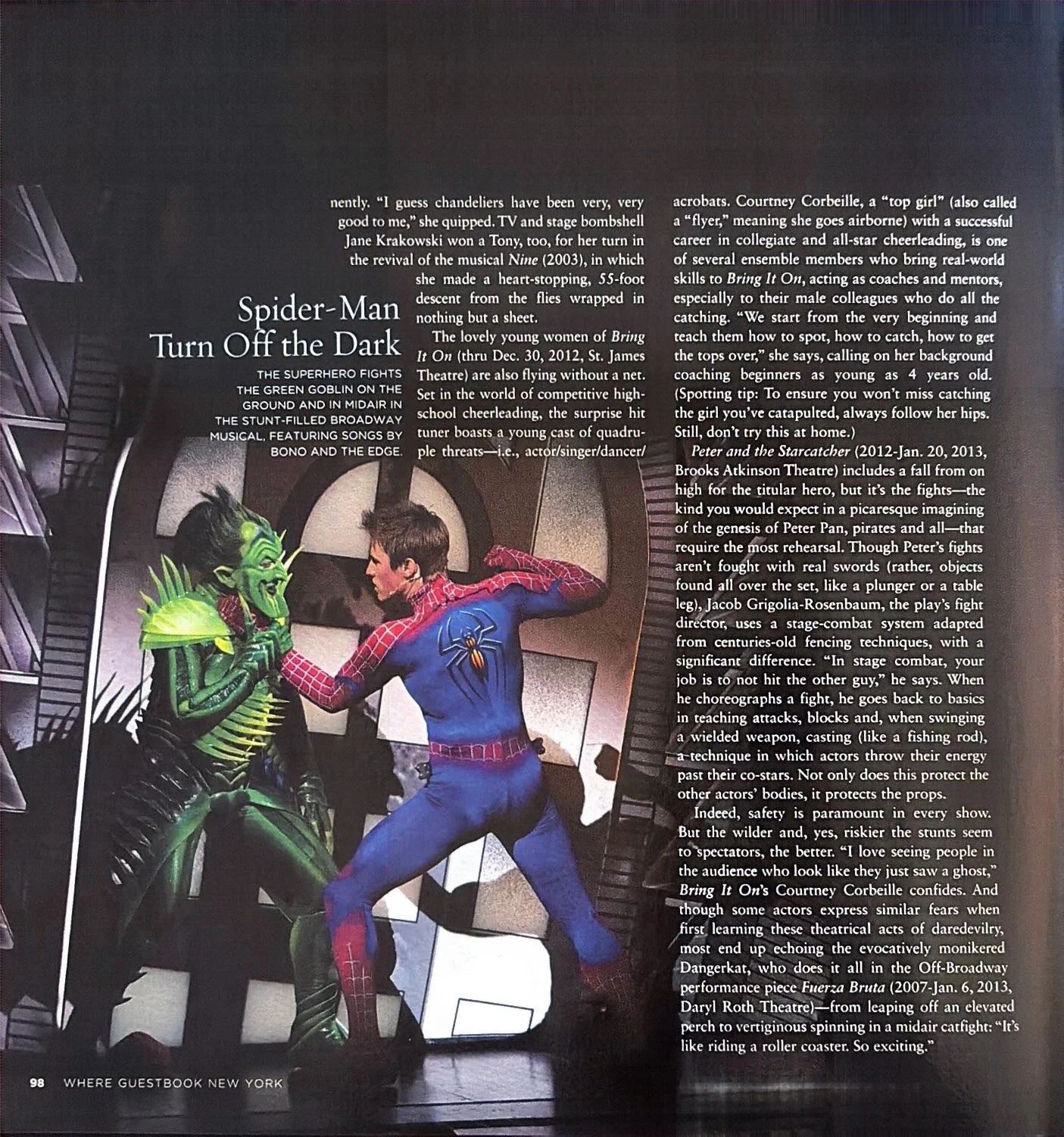
The pinnacle of flying stunts has been reached in Spider-Man Turn Off the Dark, an action-packed telling of the web-slinging superhero’s origin. To create the mega-musical’s revolutionary aerial maneuvers, the creators brought in film-industry special-effects professionals along with some Cirque du Soleil folks. It takes multiple Spider-Men to accomplish the many gasp-inducing routines, which utilize an elaborate four-point flying system that allows high-velocity soaring, swooping and flipping in any and all directions. As has been well reported, blood, sweat and tears (and many millions of dollars) were shed in the quest for high-wire perfection, but thanks in great part to its amazing stunts, Spider-Man is a hit.
Yes, spectacular stunts can be worth their weight in box-office gold—and sometimes even award gold. Among the large ensemble cast of One Man, Two Guvnors, Tom Edden was the only supporting player to get a Tony Award nomination for the lasting impression he made in a relatively small role, a codger waiter who took multiple sidesplittingly violent plunges down a staircase. In accepting her Tony for Nice Work If You Can Get It, the zany Prohibition-era show with Gershwin tunes, previously mentioned chandelier-swinging diva Judy Kaye acknowledged the significance of her much-discussed lamp dance while referencing her first Tony win for The Phantom of the Opera, in which a prop chandelier figures prominently. “I guess chandeliers have been very, very good to me,” she quipped.
TV and stage bombshell Jane Krakowski won a Tony, too, for her turn in the revival of the musical Nine, in which she made a heart-stopping, 55-foot descent from the flies wrapped in nothing but a sheet.
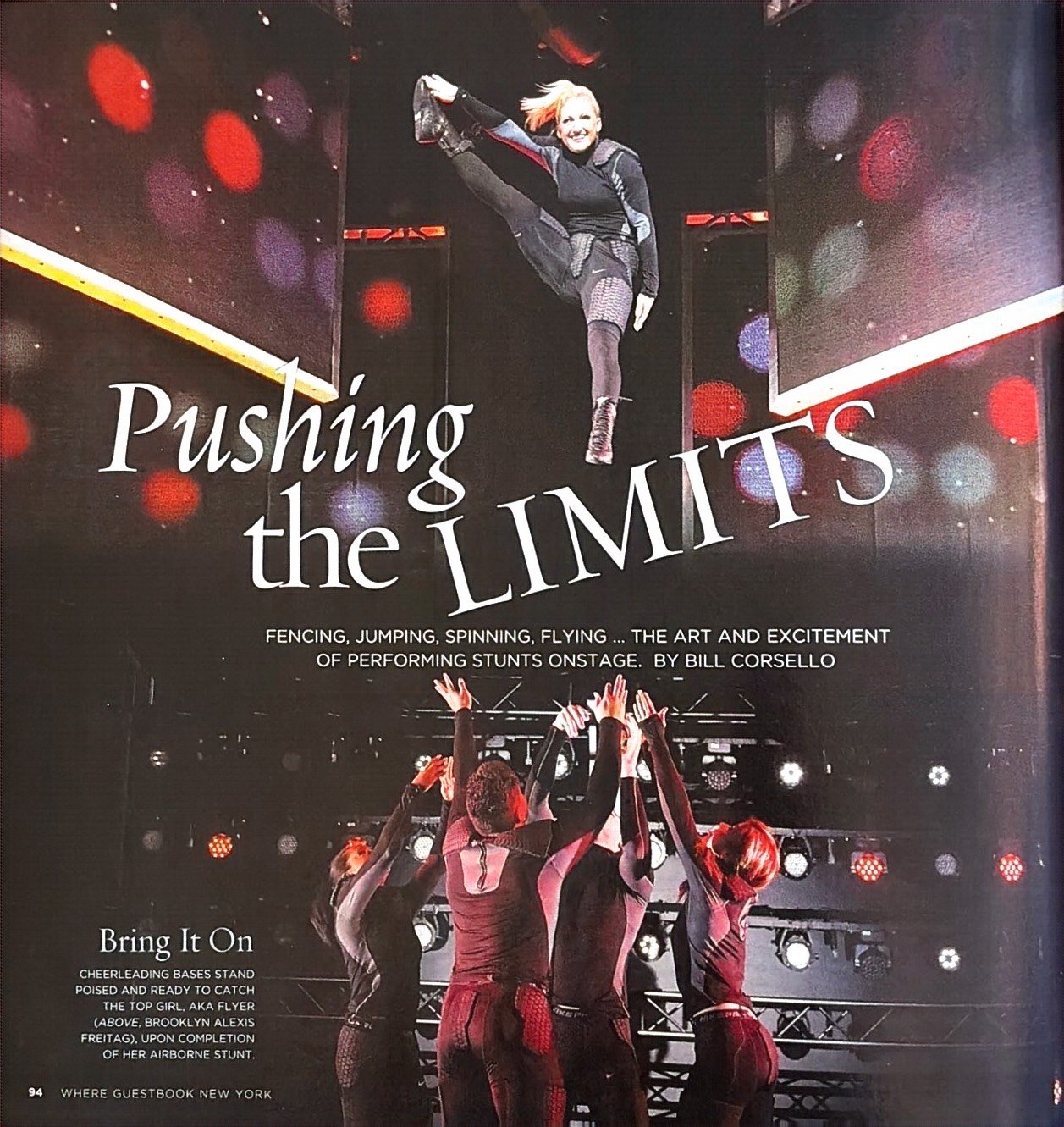
The lovely young women of Bring It On are also flying without a net. Set in the world of competitive high-school cheerleading, the surprise hit tuner boasts a young cast of quadruple threats—i.e., actor/singer/dancer/acrobats. Courtney Corbeille, a “top girl” (also called a “flyer,” meaning she goes airborne) with a successful career in collegiate and all-star cheerleading, is one of several ensemble members who bring real-world skills to Bring It On, acting as coaches and mentors, especially to their male colleagues who do all the catching. “We start from the very beginning and teach them how to spot, how to catch, how to get the tops over,” she says, calling on her background coaching beginners as young as 4 years old. (Spotting tip: To ensure you won’t miss catching the girl you’ve catapulted, always follow her hips. Still, don’t try this at home.)
Peter and the Starcatcher includes a fall from on high for the titular hero, but it’s the fights—the kind you would expect in a picaresque imagining of the genesis of Peter Pan, pirates and all—that require the most rehearsal. Though Peter’s fights aren’t fought with real swords (rather, objects found all over the set, like a plunger or a table leg), Jacob Grigolia-Rosenbaum, the play’s fight director, uses a stage-combat system adapted from centuries-old fencing techniques, with a significant difference. “In stage combat, your job is to not hit the other guy,” he says. When he choreographs a fight, he goes back to basics in teaching attacks, blocks and, when swinging a wielded weapon, casting (like a fishing rod), a technique in which actors throw their energy past their co-stars. Not only does this protect the other actors’ bodies, it protects the props.
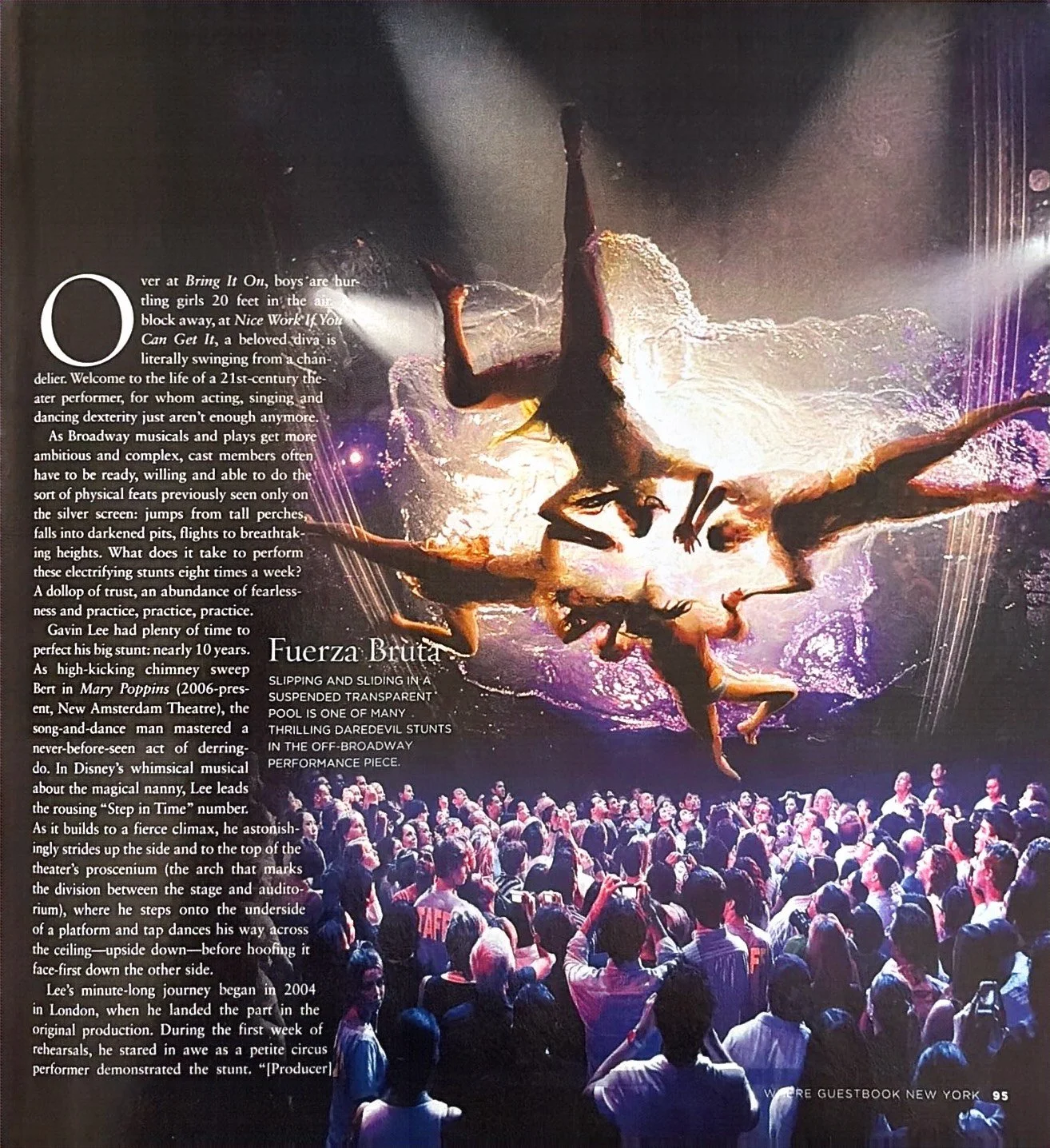
Indeed, safety is paramount in every show. But the wilder and, yes, riskier the stunts seem to spectators, the better. “I love seeing people in the audience who look like they just saw a ghost,” Bring It On’s Courtney Corbeille confides. And though some actors express similar fears when first learning these theatrical acts of daredevilry, most end up echoing the evocatively monikered Dangerkats, who does it all in the Off-Broadway performance piece Fuerza Bruta—from leaping off an elevated perch to vertiginous spinning in a midair carfight: “It’s like riding a roller coaster. So exciting.”