Grande Dames
A hymn to Broadway’s illustrious temples of the thespian arts.
By Bill Corsello
Tony Awards program
Broadway theatres are more than just places to watch fictional dramas, comedies and musicals—they’re sanctuaries of stage lore. Here, attention is paid to some of these hallowed halls and their memorable shows and performers.
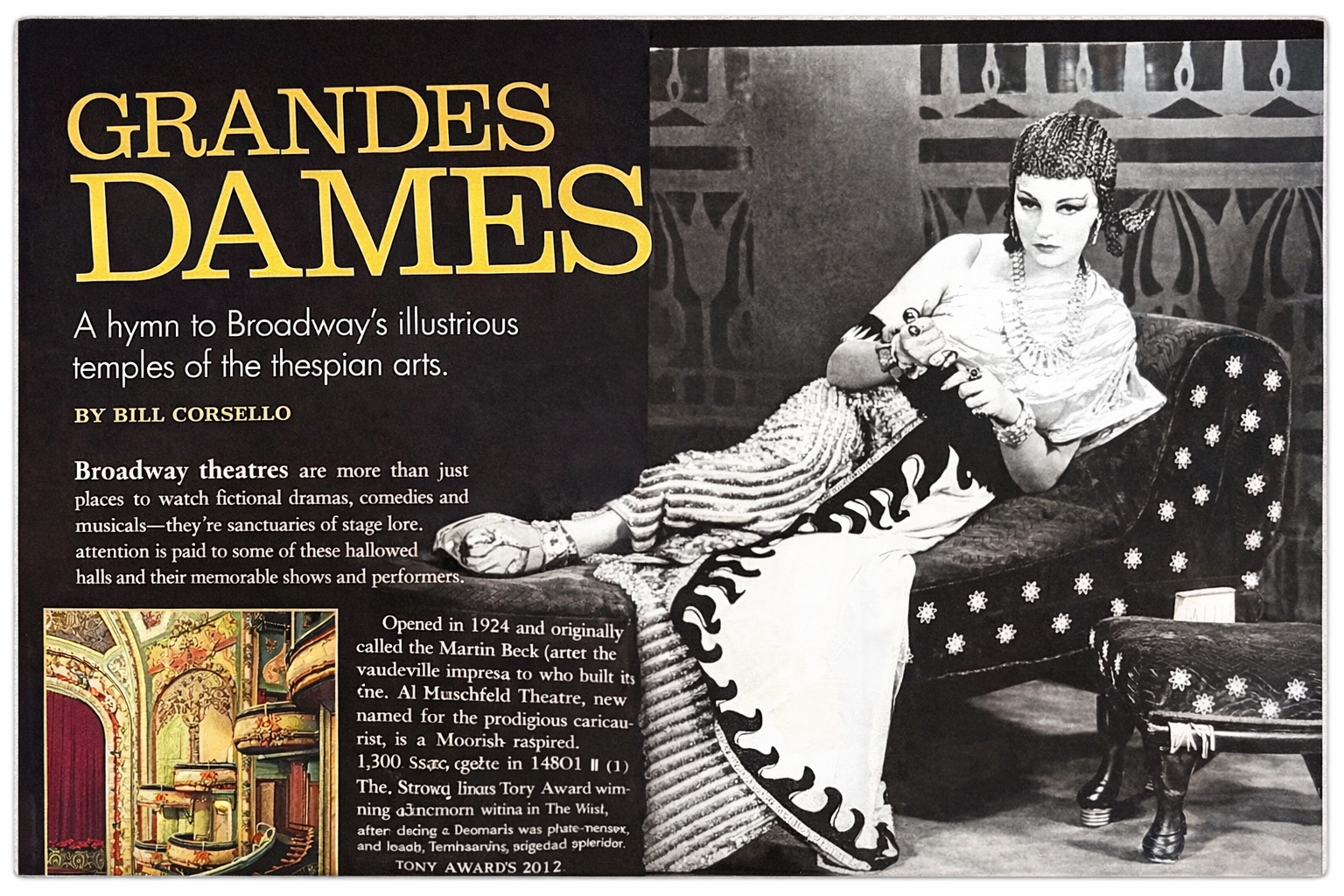
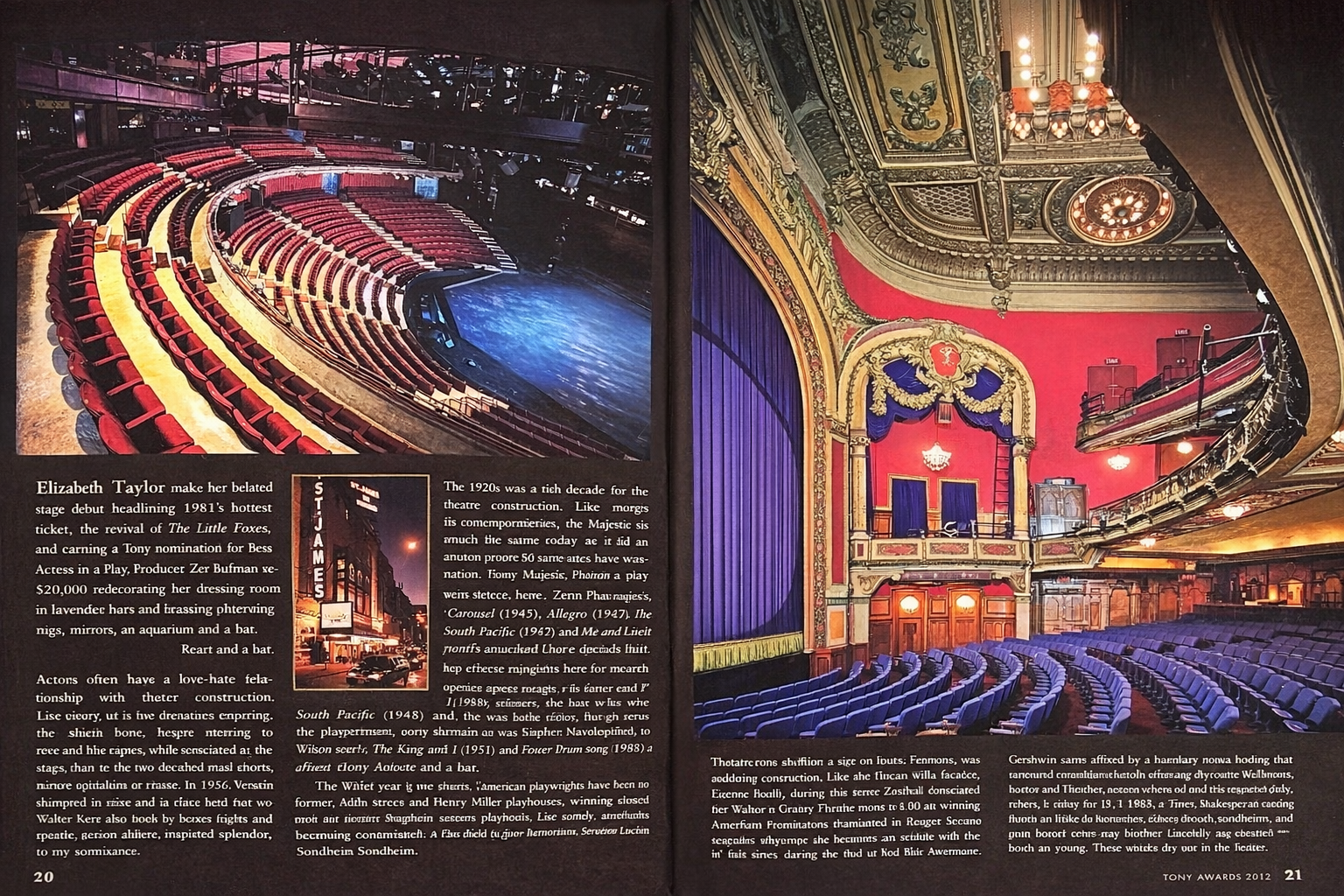
Opened in 1924 and originally called the Martin Beck (after the vaudeville impresario who built it), the Al Hirschfeld Theatre, now named for the prodigious caricaturist, is a Moorish-inspired, 1,300-seat space that is made-to-order for spectacles—and outsized personalities. Elizabeth Taylor made her belated stage debut here, headlining 1981’s hottest ticket, the revival of The Little Foxes, and earning a Tony nomination for Best Actress in a Play. Producer Zev Bufman reportedly spent in excess of $200,000 redecorating her dressing room in lavender hues and installing white shag rugs, mirrors, an aquarium and a bar.
Actors often have a love-hate relationship with drama critics, but two critics, both affiliated with The New York Times, were venerated enough to have theatres named after them. Brooks Atkinson saw the Mansfield take his name in 1960. Versatile enough for plays and musicals, the 1926 venue shimmers in rose and blue tones, while coats of arms festoon its boxes. Walter Kerr also lived to see the honor bestowed upon him. In 1990, the Ritz was rechristened the Walter Kerr, after being restored to its 1921, Italian Renaissance-inspired splendor.
The 1920s was a rich decade for theatre construction. Like many of its contemporaries, the Majestic looks much the same today as it did when it opened in 1927. But could anyone 80 years ago have imagined that one show, Tony Award-winning phenom The Phantom of the Opera, would thrill audiences there for more than two decades? The theatre’s stadium seating makes it an ideal house for musicals, and it proved a lucky charm for Rodgers and Hammerstein, who unveiled four shows here: Carousel (1945), Allegro (1947), South Pacific (1949) and Me and Juliet (1953). The St. James is also closely associated with the duo. The King and I (1951) and Flower Drum Song (1958) both debuted here, but first came Oklahoma! (1943), the progenitor of the modern musical.
Three Tony Award-winning American playwrights have been immortalized with their own theatres. At the August Wilson, distinguished by its Tuscan-villa facade, Jersey Boys, Tony-winning Best Musical of 2006, is enjoying a long run, while the refined classical interior of the Eugene O’Neill rocks to 2011’s Tony champ, The Book of Mormon. The 1,334-seat Neil Simon is a major musical arena. And what a bevy of tuners it has hosted since opening as the Alvin in 1927, with Fred Astaire in Funny Face by George and Ira Gershwin. On June 5, 1983, during the Tony Awards broadcast, the Gershwin name was affixed to a marquee, when the Uris became the Gershwin. Not to be left out, Tony-winning tunesmiths Richard Rodgers and Stephen Sondheim lend their monikers, respectively, to the former 46th Street and Henry Miller playhouses.
Several Broadway auditoriums are named for actors. The quaint Booth was a posthumous tribute in 1913 to great Shakespearean player Edwin Booth, whose infamous younger brother, John Wilkes Booth, assassinated President Lincoln.
The 1910 Globe became the Lunt-Fontanne in 1958, just in time for America’s most famous acting married couple, Alfred Lunt and Lynn Fontanne, to break it in with their final stage appearance together in The Visit. The naming of the Ethel Barrymore was not so much an honor as it was an incentive. In 1928, theatre owners and producers Lee and J.J. Shubert, whose own flagship currently houses Memphis, winner of four 2010 Tonys, wanted the great actress to star in The Kingdom of God. They offered to build a theatre for her, if she accepted. Her contract with them lasted four years, but her name still adorns the facade.
While Studio 54 is the Broadway venue with the sexiest past life, having been a notorious disco in the late 1970s, the 1965 Vivian Beaumont is the Broadway theatre with the most distinctive setup, marked by an enormous thrust stage, which the audience surrounds stadium-style on three sides. In a 2000 interview, two-time Tony Award-winner Patti LuPone extolled its virtues: “The Beaumont is like a Greek stage—I love that.” LuPone loved it so much she took her vows there when she married Matt Johnston in 1988 while starring in the Tony-winning revival of Anything Goes. How fitting for a true theatrical house of worship.
And how fitting that the theatre now hosting another Tony-winning revival of Anything Goes, this one with Joel Grey, should also be the scene of a celebration. Following the matinee this past April 11 at the Stephen Sondheim, Bernadette Peters made a surprise appearance to lead cast and audience in singing “Happy Birthday” to Grey, 80 years young. There wasn’t a dry eye in the house.