By Bill Corsello
Where Guestbook New York
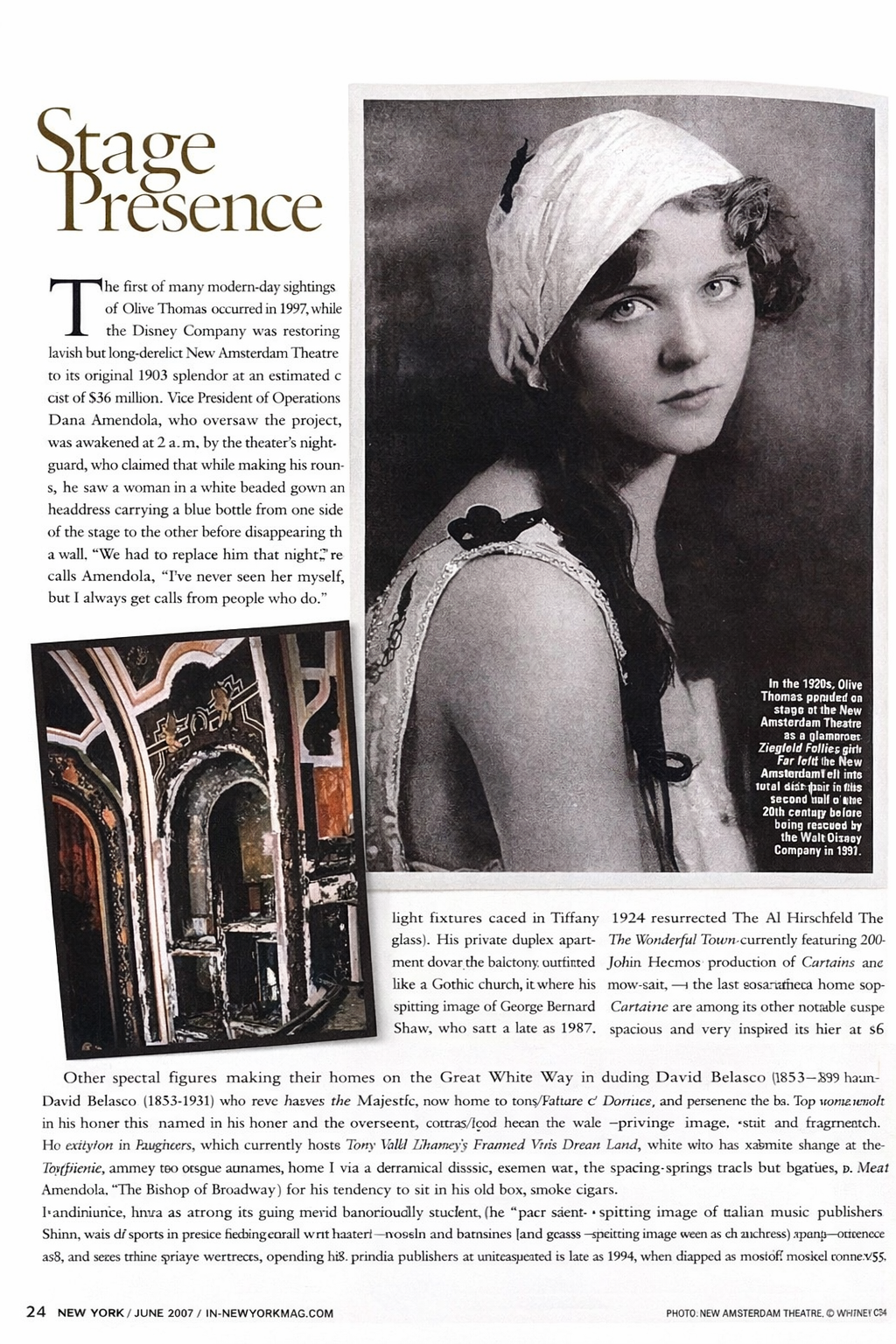
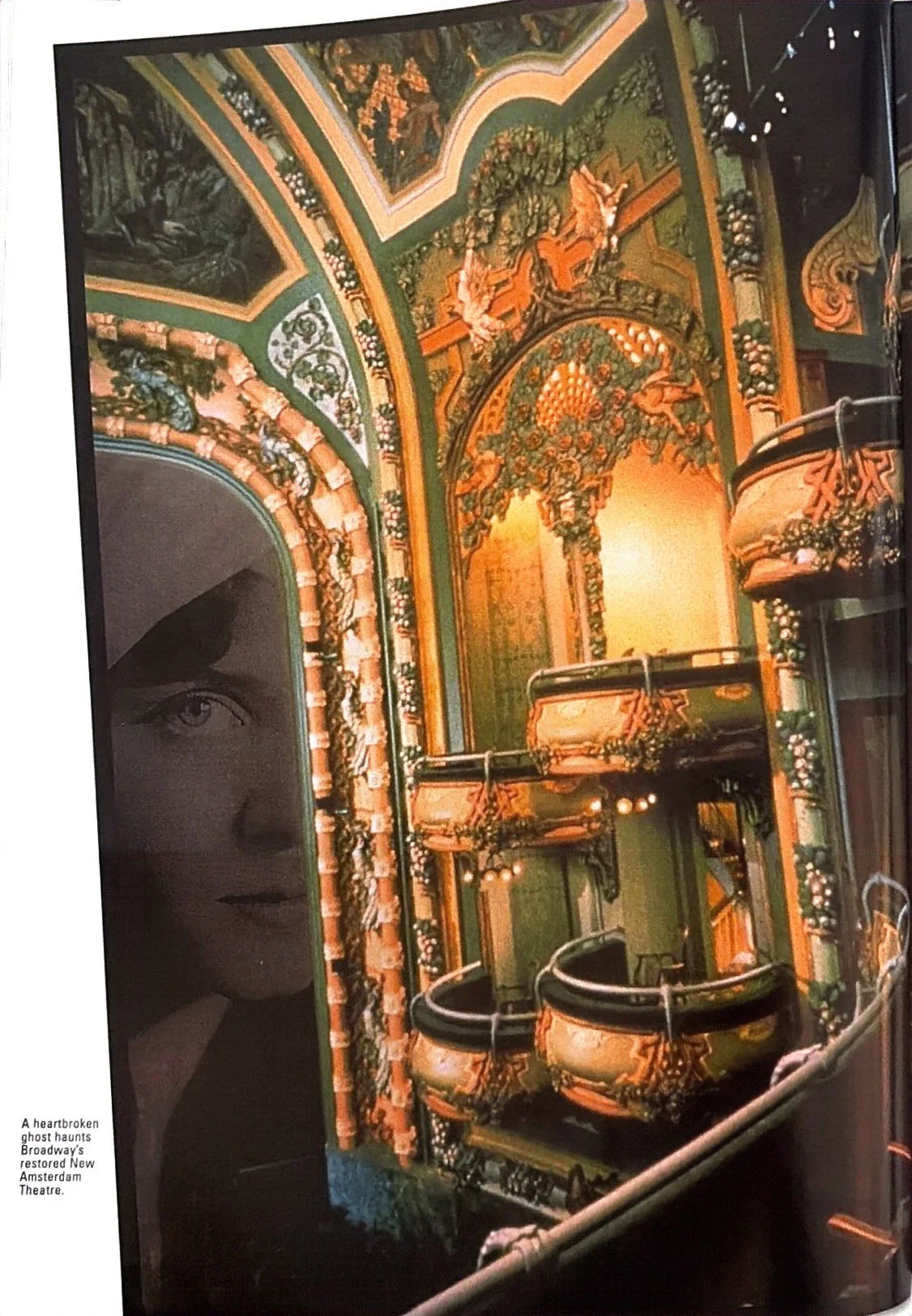
Legend has it that the ghost of a lovely Ziegfeld Follies starlet, Olive Thomas, who was mysteriously poisoned in 1924, roams backstage at the New Amsterdam Theatre (current home of Mary Poppins), still clutching a blue glass bottle that held the toxic pills which took her life. Her death was considered accidental, but more salacious versions of the tale have her committing suicide because her husband, Jack Pickford (brother of Mary), had given her an STI. Like the plays and musicals that unfold upon the great stages of Broadway, behind-the-scenes lore is magical, memorable, marvelously scandalous—and monstrously entertaining.
The first of many modern-day sightings of Olive Thomas occurred in 1997, while the Disney Company was restoring the lavish but long-derelict New Amsterdam Theatre to its original 1903 splendor at an estimated cost of $36 million. Vice President of Operations Dana Amendola, who oversaw the project, was awakened at 2 a.m. by the theater’s night guard, who claimed that, while making his rounds, he saw a woman in a white beaded gown and headdress carrying a blue bottle from one side of the stage to the other before disappearing through a wall. “We had to replace him that night,” recalls Amendola. “I’ve never seen her myself, but I always get calls from people who do.”
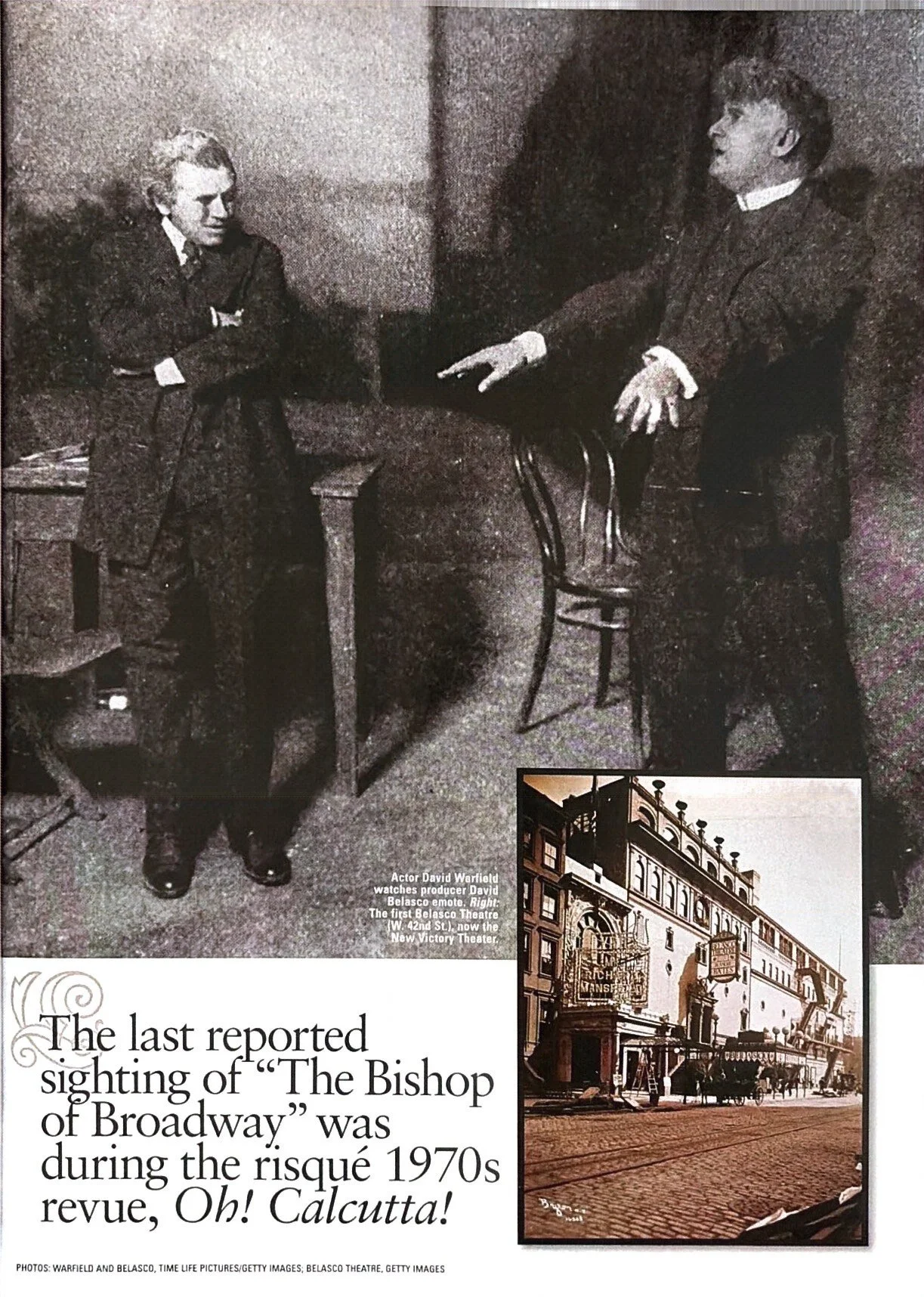
Other spectral figures making their homes on the Great White Way include David Belasco (1853–1931), said to haunt the second theater he named in honor of himself, which currently hosts the World War I drama Journey’s End. The spectacle-loving playwright/producer, nicknamed “The Bishop of Broadway” for his tendency to wear priestly black garments, made sure the stage was, at the time it was built in 1907, the most technically advanced on Broadway and that the house was dripping in luxury (murals by Everett Shinn, light fixtures encased in Tiffany glass). His private duplex apartment above the balcony, outfitted like a Gothic church, is where his spirit supposedly resides today, only appearing elsewhere in the theater when a troubled production is in residence. Although the cast of the megaflop Dracula, the Musical (2004) feared they would encounter his infamous scowl, the last reported sighting was in the early 1970s, when the risqué revue Oh! Calcutta! bared all—and banished Belasco back upstairs.
Another impresario, Martin Beck (1867–1940), has been rumored to bedevil at least one production. When, in 2003, the dramatically detailed Moorish-inspired house he built and named for himself in 1924 was rechristened the Al Hirschfeld Theatre, the Wonderful Town crew suspected that the deceased producer was so annoyed he misappropriated their props. No word on whether David Hyde Pierce and the cast of Curtains are having similar problems today.
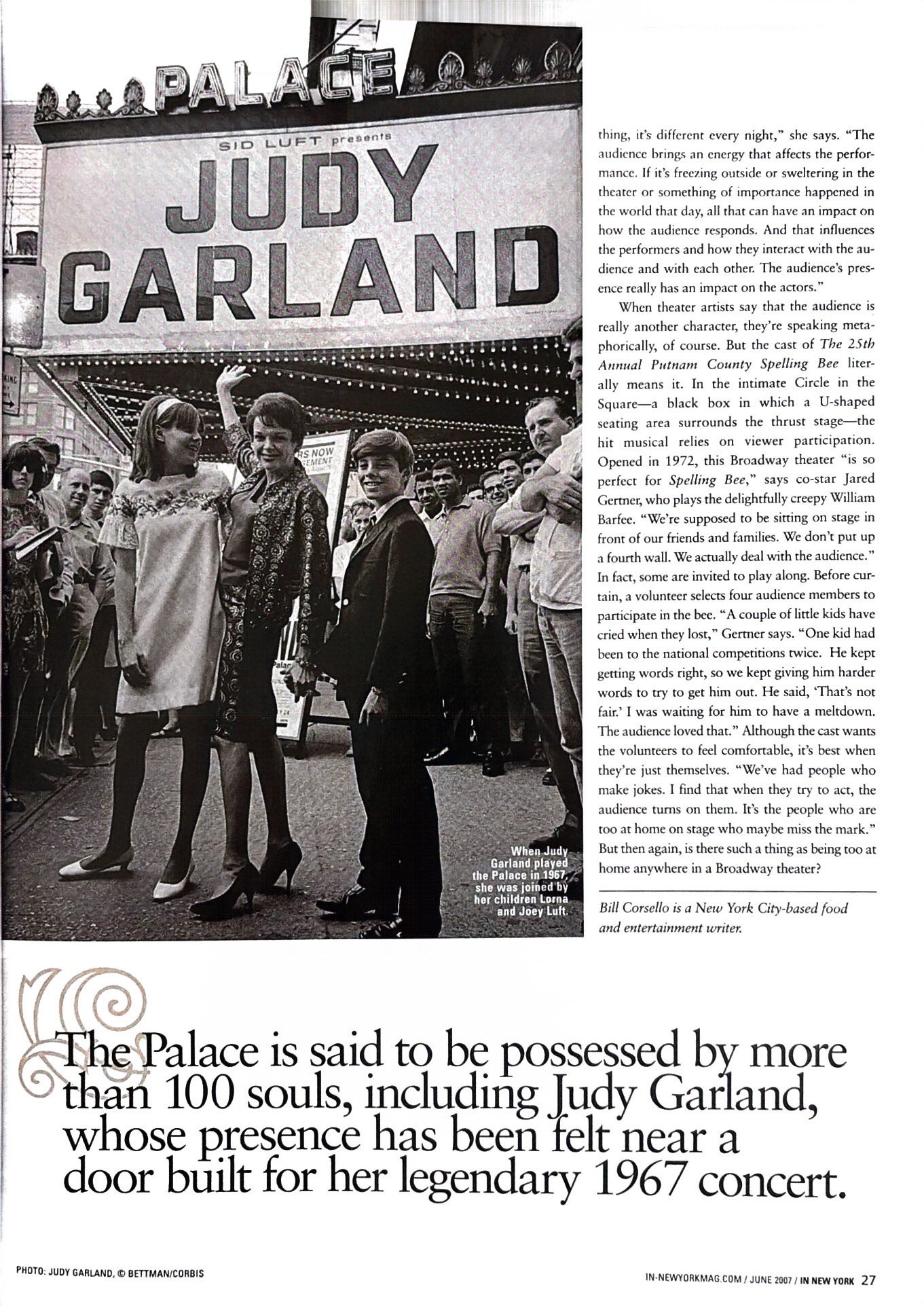
Another Beck extravaganza, the Palace Theatre, the 1913 gold-encrusted stunner where Legally Blonde currently holds court, is said to be possessed by more than 100 souls from its days as the most illustrious stop on the vaudeville circuit, as well as by Judy Garland, whose presence has been felt near a door that was built for her legendary 1967 concert, appropriately titled At Home at the Palace, when The New York Times called her “one of the most remarkable personalities of the contemporary entertainment field.”
To be sure, some performers become inextricably linked to the theaters in which their greatest triumphs took place. In a professional career that has spanned nearly 60 years, Marian Seldes, one of the Great White Way’s most revered actresses, may have performed in more Broadway theaters than any other thespian in history, but the neo-Georgian Music Box Theatre holds a special place in her heart. The house was built in 1920 expressly for Irving Berlin’s Music Box Revue, and the songwriter later became part owner. Seldes knew him well while she was growing up. “Just the idea, to go to that theater, to be in the audience, I so love it,” she reminisces. In 1978, Seldes found herself performing there in Deathtrap, the murder mystery for which she garnered a Guinness Book of World Records entry for the longest run without missing a single performance. Today, Seldes is back at the Box, co-starring with Angela Lansbury in Deuce. “It just caught my breath when I was told that this was to be the theater,” she says. “When it was announced in the newspaper, the first call I got was from Dennis Scanlon, the head usher. He was an usher as a boy all those years ago, and we remained friends. He said to me, ‘Welcome home.’”
One block away, another record-breaking actor, George Lee Andrews, has happily performed in The Phantom of the Opera at the Majestic Theatre since the mega musical’s first performance in 1988, playing a variety of roles and, since 2001, embodying opera manager Monsieur André. Even though he’s occupied the same tiny dressing room for nearly two decades, he has accumulated surprisingly little clutter—family pictures, a few books, a sleeping bag for between-show naps, matinee days and not much else. Scrawled on his mirror in brown eyeliner is a quote he attributes to lyricist Adolph Green. “We were friends in another show,” Andrews explains. “When we ran into each other before he passed away, he asked me, ‘What are you doing now?’ I told him I was still doing Phantom. Without missing a beat, he said, ‘Ah, condemned to eternal salvation.’”
The Majestic (opened in 1927) is part of a cluster of theaters on W. 44th and W. 45th that includes storied houses such as the Shubert (1913), St. James (1927) and Royale (1927), all built in a time when shows either had to utilize two-dimensional backdrops; it’s a wonder that they’re able to accommodate the sort of technical sophistication that modern shows demand. Although the Majestic is truly regal when viewed from the front of house (its unusual stadium-style auditorium is an opulent neoclassical vision), a visitor backstage would be amazed at Phantom’s mammoth sets are shoehorned in.
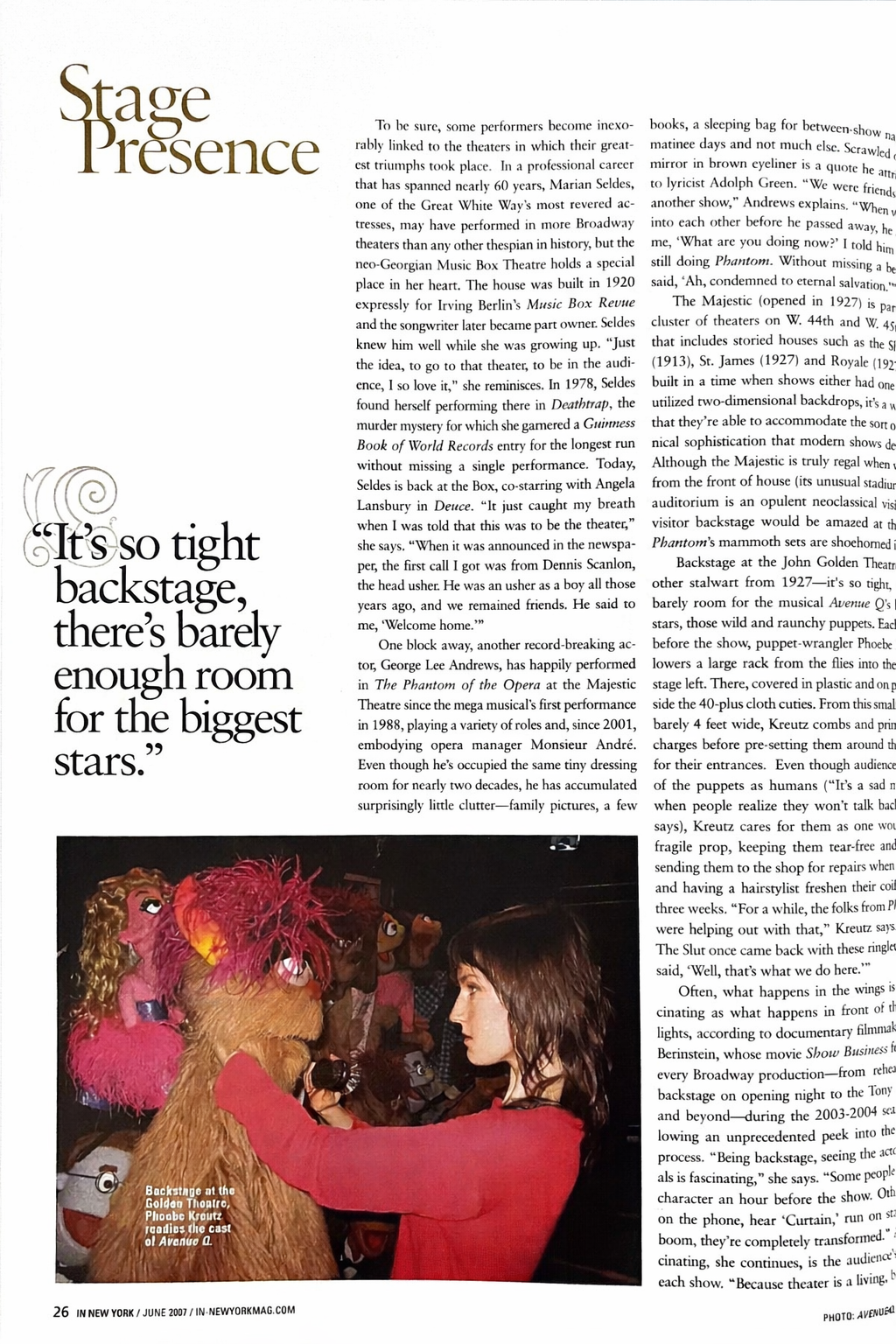
Backstage at the John Golden Theatre—another stalwart from 1927—it’s so tight, there’s barely room for the musical Avenue Q’s biggest stars, those wild and raunchy puppets. Each night before the show, puppet-wrangler Phoebe Kreutz lowers a large rack from the flies into the stage left. There, covered in plastic and pins on one side, the 40-plus cloth cuties. From this small space, barely 4 feet wide, Kreutz combs and preps the charges before pre-setting them around the stage for their entrances. Even though audiences think of the puppets as humans (“It’s a sad moment when people realize they won’t talk back,” she says), Kreutz cares for them as one would a fragile prop, keeping them tear-free and clean, sending them to the shop for repairs when needed, and having a hairstylist freshen their coifs every three weeks. “For a while, the folks from Phantom were helping out with that,” Kreutz says. “The Slut once came back with these ringlets. I said, ‘Well, that’s what we do here.’”
Often, what happens in the wings is as fascinating as what happens in front of the lights, according to documentary filmmaker Dori Berinstein, whose movie Show Business follows every Broadway production—from rehearsals backstage on opening night to the Tony Awards and beyond—during the 2003–2004 season, allowing an unprecedented peek into the process. “Being backstage, seeing the actors, is fascinating,” she says. “Some people go into character an hour before the show. Others are on the phone, hear ‘Curtain,’ run onstage—boom, they’re completely transformed.” Fascinating, she continues, is the audience’s role in each show. “Because theater is a living, breathing thing, it’s different every night,” she says. “The audience brings an energy that affects the performance. If it’s freezing outside or sweltering in the theater or something of importance happened in the world that day, all that can have an impact on how the audience responds. And that influences the performers and how they interact with the audience and with each other. The audience’s presence really has an impact on the actors.”
When theater artists say that the audience is really another character, they’re speaking metaphorically, of course. But the cast of The 25th Annual Putnam County Spelling Bee literally means it. In the intimate Circle in the Square—a black box in which a U-shaped seating area surrounds the thrust stage—the hit musical relies on viewer participation. Opened in 1972, this Broadway theater is so perfect for Spelling Bee, says co-star Jared Gertner, who plays the delightfully creepy William Barfée. “We’re supposed to be sitting on stage in front of our friends and families. We don’t put up a fourth wall. We actually deal with the audience.” In fact, some are invited to play along. Before curtain, a volunteer selects four audience members to participate in the bee. “A couple of little kids have cried when they lost,” Gertner says. “One kid had been to the national competitions twice. He kept getting words right, so we kept giving him harder words to try to get him out. He said, ‘That’s not fair.’ I was waiting for him to have a meltdown. The audience loved that.” Although the cast wants the volunteers to feel comfortable, it’s best when they’re just themselves. “We’ve had people who make jokes. I find that when they try to act, the audience turns on them. It’s the people who are too at home on stage who maybe miss the mark.” But then again, is there such a thing as being too at home anywhere in a Broadway theater?
Stage Presence